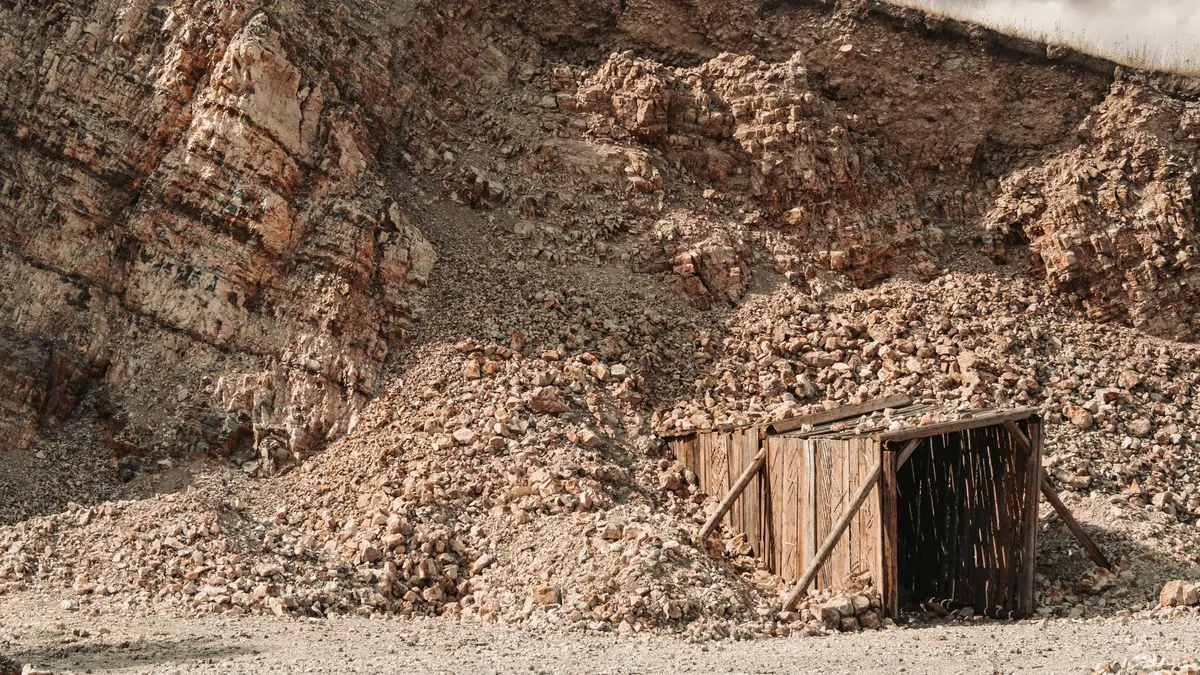
Five Common Knapping Mistakes and How to Fix Them
Five Common Knapping Mistakes and How to Fix Them
Every knapper's waste pile tells the truth. Hinge fractures stacked like roof tiles, step fractures that no amount of pressure will shift, and a core that began the morning full of promise and now looks like a bag of gravel. None of that is bad luck. Knapping is a conversation between your striker, your platform and the mass of stone underneath, and most mistakes are simply interruptions in that conversation. The five below come up again and again. Each has a fix you can try on the very next flake, which is the best thing about this craft: the stone gives you feedback immediately.
The platform you never prepared
Every controlled removal starts with a platform: the small surface you intend to strike. If it is rounded, crumbly, or sitting at the wrong angle to the face you want the flake to travel along, no amount of force will save it. The striker skids, the platform shears, and you are left with a bruise and a stubby flake.
The fix is dull, repetitive work, and it is the most reliable investment you can make in a flake. A good platform is not simply a place to hit. It is a carefully shaped ramp. It needs to be slightly convex, strong enough to hold the energy of the strike, and angled so the force travels into the stone rather than skipping off the surface. When knappers talk about “setting up a platform,” they mean all of that at once.
What a good platform looks like
- It is abraded, not smooth. A freshly ground edge gives the striker traction.
- It sits at roughly ninety degrees to the face you want the flake to follow, or slightly less for thinning flakes.
- It has enough thickness to support the blow without crushing.
- It is isolated from nearby ridges and step fractures that might steal the force.
Imagine trying to split a log with a dull axe and a rounded stump. You can swing hard all day, but the axe will glance off. The same thing happens when you strike a smooth, rounded platform. The hammerstone or billet slides, the energy dissipates, and the stone beneath remains unchanged. Now imagine a flat stump, a sharp axe, and a clean line of attack. That is a prepared platform.
How to prepare it
- Abrade the edge with a coarse stone, a rasp, or even a piece of sandstone. Grind until the edge is dull and white.
- Remove any overhangs or crushed material with a light pass of the hammer.
- Turn the piece and check the angle. If the platform is too steep, the flake will hinge. If it is too shallow, the flake will run out.
- Test the platform with a light tap before committing to a full strike. Listen for a clean, solid sound.
If you only do one thing after reading this, make it this: spend twice as long preparing the platform as you think you need. The flake will come off faster, thinner, and with far less effort.
Striking too hard, too often, too soon
Force feels like control. It is not. When a flake refuses to travel, the instinct is to hit harder. But a hard strike on a bad setup does not fix the problem; it magnifies it. You get a hinge, a step, or a shattered platform, and now you have two problems instead of one.
The fix is to dial back the power and increase the precision. Most good flakes are removed with a crisp, controlled strike, not a wild swing. The energy should be delivered through the platform, not into the stone like a hammer on a nail. Think of it as pushing a wave through the rock rather than trying to break it in half.
A simple diagnostic
- If your flakes are short and thick, you are probably striking too hard or too far from the edge.
- If the hammer bounces off the platform, your angle is wrong or the platform is too smooth.
- If you are sweating after five flakes, you are working too hard. Good knapping looks almost lazy from a distance.
Try counting your strikes. Give yourself a limit of three firm strikes on a single platform. If the flake has not released by then, stop and reset. That one habit will save more stone than any expensive tool.
Ignoring the centerline and convexity
A biface is not a flat piece of stone that you chip into a knife. It is a three-dimensional shape with a centerline, and every flake you remove changes the geometry. When you ignore the centerline, you create flat spots. Flat spots stop flakes. They cause hinges and steps because the energy has nowhere to travel except straight into the mass of the stone.
The fix is to keep the surface convex from edge to edge and from end to end. Imagine a turtle shell or a shallow dome. Flakes want to travel across a convex surface because the ridge lines guide them. When the surface is flat, the flake stalls.
“A biface is not a shape you carve; it is a shape you keep revealing.”
In practice, this means alternating your strikes from side to side and end to end. If you remove a flake from the left edge, look at how it changed the centerline. Then remove the next flake from the opposite side to bring the ridge back to the middle. Chase the high spots. If you see a ridge running down the middle, strike so the flake travels along that ridge rather than across it.
Letting a bad flake dictate the next step
This is the most expensive mistake because it compounds. You remove a flake and it hinges. Instead of stopping, you hit the same spot again, trying to “fix” it. The hinge gets deeper. You hit harder. Now you have a step fracture. You try a different angle. The platform crushes. Ten minutes later, the point is half the size it was and covered in scars.
The fix is to stop immediately when a flake fails. A bad flake is information, not an emergency. It tells you the platform was wrong, the angle was too steep, or the surface was too flat. The next strike should be a deliberate response to that information, not an attempt to erase it.
The three-second reset
- Stop. Take the tool away from the stone.
- Look at the failed flake. Where did it terminate? Why did it stop?
- Choose a new platform, a new angle, or a new flake entirely. Sometimes the best move is to remove a flake from the opposite side and meet the problem from behind.
If a hinge or step is too deep to recover, do not force it. Turn the piece over. Use the other face. Or set it aside and come back later. Stone is patient, even when we are not.
Skipping abrasion and edge maintenance
New knappers often treat abrasion as optional, something you do only when the edge gets too sharp. But abrasion is not a luxury. It is the difference between a platform that holds and a platform that crumbles. Every time you remove a flake, the edge becomes weaker, thinner, and more irregular. If you do not abrade, the next strike will crush the edge instead of detaching a flake.
The fix is simple: abrade before every removal. A few seconds with a coarse stone will strengthen the edge, remove overhangs, and give your striker something to bite into. It feels slow at first. Then you notice that your flakes are longer, your platforms are cleaner, and your hands are less sore.
Abrasion habits that pay off
- Keep a coarse abrasive stone within reach at all times.
- Grind the whole edge, not just the spot you plan to hit.
- Re-abrade after every flake or two, especially on brittle stone like obsidian or chert.
- Use a light touch. You are strengthening the edge, not grinding the piece away.
If your platform crushes and you hear a dull thud instead of a clean tick, that is your cue. Stop, abrade, and try again. The stone will tell you immediately whether you listened.
Extra practice: the three-flake reset drill
One of the best ways to break these habits is to practice with a strict reset. Choose a piece of stone and remove only three flakes. After each flake, stop and inspect the platform, the edge, and the surface. Then reset: abrade, check the angle, and plan the next strike.
- Flake one: remove a small thinning flake from a prepared platform.
- Flake two: turn the piece and remove a flake from the opposite side, aiming to keep the centerline.
- Flake three: choose the most difficult platform you can find and remove a controlled flake without crushing it.
Then stop. Do not chase the shape. Look at the three flakes you produced. If they are thin, feathered, and predictable, your setup is working. If they are short, hinged, or crushed, you know exactly what to fix next time.
Reading the waste pile like a teacher
Your debitage is a record of every decision you made. Instead of sweeping it away, take a minute to sort through it. You will learn more from ten failed flakes than from one lucky success.
- Hinge fractures mean the angle was too steep or the platform was too close to the surface.
- Step fractures mean the platform was crushed, too weak, or struck with too much force.
- Short, thick flakes mean you were not following the convexity or the ridge lines.
- Long, thin, feather-terminated flakes mean your platform, angle, and force were in agreement.
Keep a few of your best and worst flakes in a jar. Over time, the jar becomes a dictionary. You will start to recognize the sound and feel of a good strike before the flake even leaves the core.
When to stop for the day
Fatigue is a knapping mistake all by itself. When your hands ache, your eyes tire, and your patience thins, your platforms get sloppy. You start forcing flakes. You stop resetting. You make the same mistake five times in a row and blame the stone.
The fix is to set a stopping point before you begin. Maybe it is when you fill a small bucket with debitage. Maybe it is when you catch yourself striking without thinking. Maybe it is simply when the light changes. Put the piece down, wrap it up, and leave the next step for tomorrow. The stone will still be there, and your hands will be fresher.
Knapping rewards attention more than strength. Prepare the platform, use less force, respect the centerline, stop when a flake fails, and abrade like you mean it. Do those five things and your waste pile will start telling a different story: one of long, clean flakes and a core that still looks like it has a future.
Photo: andreas160578 / Pixabay
Seasonal Tinder: What to Collect in Each British Month for Flint Sparks
A month-by-month British guide to gathering dry natural tinders — birch bark, thistle down, reed mace and...
Flint vs Chert: How to Tell Them Apart in the Field
Flint is a kind of chert, but the two behave differently under a hammerstone. Here's how to read colour,...
About Us